Current: Saves your experts up to 70% of the writing time per decision.
Current writes the reasoning behind your experts' decisions: lawyers, auditors, claims handlers. Based entirely on your own archive and guidelines, with a source reference for every paragraph.

- less time per case
- 50–70%
- from decision to draft reasoning
- 25 s
- of the generated text was accepted straight away
- 81%
a much-needed efficiency gain
A 35% rise in workload because of AI
-
You receive more letters, and longer ones
Customers, residents and counterparties use AI tools to write their submissions. In our research we saw workload rise by 35% in just five years.
-
Reinventing the wheel, again and again
The answer is usually already in your archive, but your expert can't easily get to it. Standardising the reasoning is hard, because every expert has their own way of writing.
-
The cost is in the reasoning
Your staff's expertise lies in the decision, and that takes a quarter of an hour. Writing the letter takes 3–16 hours.
applications
Finally put the knowledge and value hidden in your organisation to work
Current opens up the wealth of knowledge your organisation already holds, so the reasoning for a decision is drafted automatically in seconds. Every paragraph refers to its source, so your expert can check exactly whether everything is right.
-
insurers · implementing organisations
Claims and complaints
Claim decisions, complaint responses, statements of defence. High volumes, a fixed structure and an archive of earlier answers.
-
certification and inspection bodies
Audit reports
The lead auditor sets the verdict and nonconformities; Current writes the report against the standard, in line with earlier reports.
-
engineering and advisory firms
Expert assessments
The expert reaches the conclusion; Current writes the substantiation in line with earlier assessments of the same kind.
-
municipalities · in use
Decisions on objections
Fines, towing, parking, benefits. The case handler rules on the objection; Current writes the decision from earlier letters on the same subject. This is where the pilot ran.
-
environmental services · provinces
Permits
Permits, exemptions and enforcement decisions. The officer decides; Current writes the considerations and conditions in line with earlier decisions.
-
airlines · airports
Aviation
Compensation claims under EU Regulation 261/2004 and passenger complaints. The claims handler decides whether extraordinary circumstances apply; Current writes the response in line with earlier decisions.
Missing your document type? Current fits when an expert decides, there is an archive of similar documents, the structure is fixed and writing takes hours.
Ask ushow it works
Smart automated reasoning, always under an expert's control
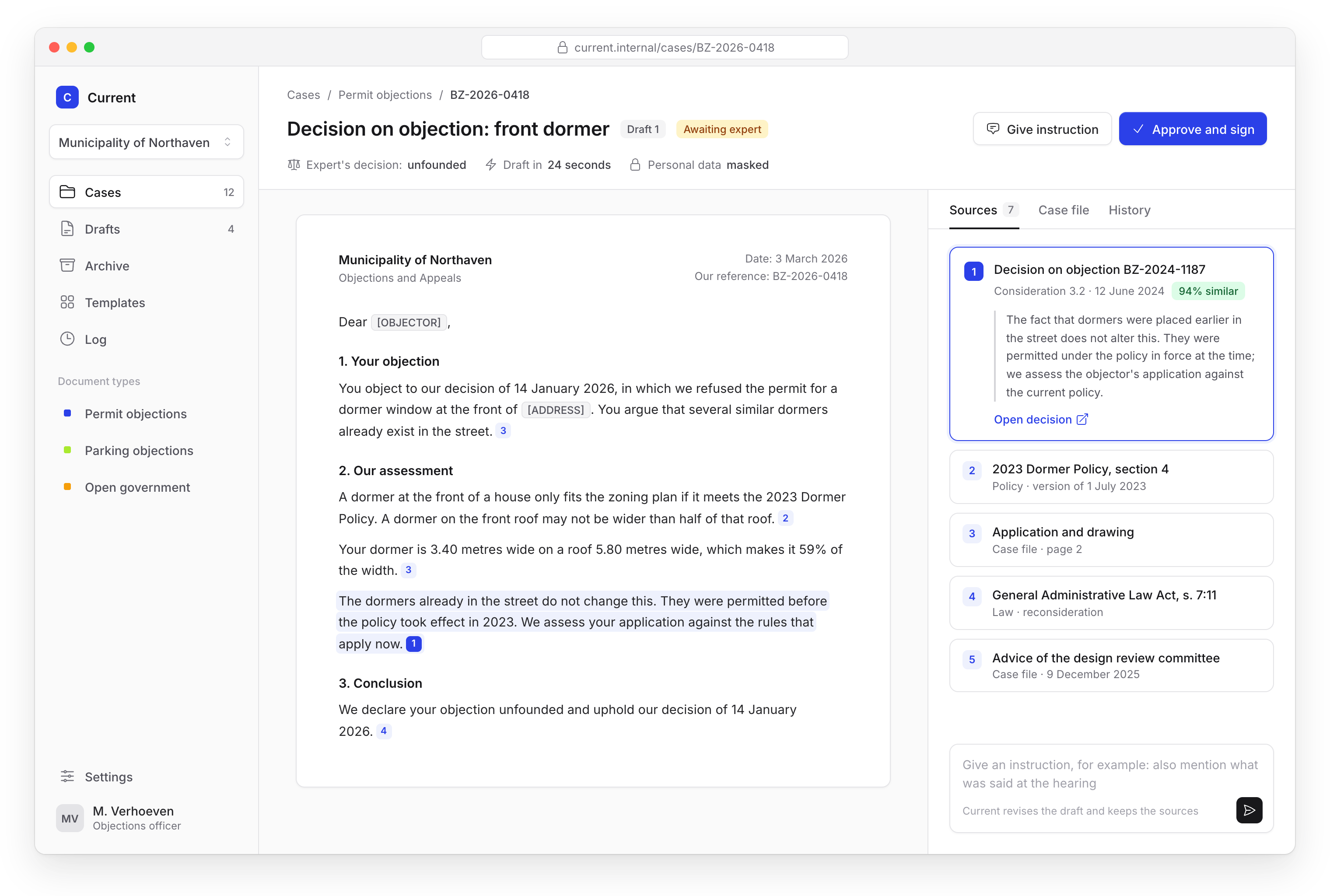
The expert makes the decision. Current writes the draft reasoning from relevant earlier reasoning in your archive. Every step refers to its source, and the expert has to review and approve all of the text.
Built for the most sensitive cases
Working with AI doesn't have to mean compromising on regulation and compliance. Motion Delta is a Dutch company and develops Current entirely within European guidelines and regulations.
-
“Our data can't leave the building.”
It doesn't have to. Current runs in your own environment in the EU. Personal data is masked before processing and only restored on export. The language model sees only the passages for that one case, and nothing is used for training.
-
“AI is unreliable and makes things up.”
Current writes nothing of its own accord. Every part of the draft comes from passages in your archive and the rules behind them, with the source alongside. Our measurements show that all key facts were correct in over 99% of drafts, and the expert caught the rest while reviewing. The system cannot send a letter itself, and experts cannot skip the review step.
Chances are your experts already use AI. With Current you stay in control of how they use it.
an example
Every passage traceable to a rule, standard or earlier decision

fast implementation
Live in ten weeks
No big, long-running IT project. In a short, intensive implementation our specialists work with your team to connect Current to your systems. After that, Current is ready to use straight away.

faq
Frequently asked questions
-
Can AI write the reasoning for a decision?
Yes, as a draft that an expert checks and signs. Current writes the reasoning once the expert has decided, using passages from your own earlier decisions and the rules behind them, with the source next to every paragraph. The expert reviews, adjusts and approves the text. In our measurements the draft is ready 25 seconds after the decision, and 81% of the generated text was accepted straight away.
-
How do we keep up with the rise in AI-written objections and complaints?
Let Current do the writing. Customers, residents and counterparties now write their objections and complaints with AI tools, so there are more of them and they are longer. In our research the workload rose by 35% in five years. Once the case handler has ruled, Current drafts the decision from earlier letters on the same subject, which saves 50 to 70% of the time per case.
-
How is Current different from ChatGPT or Copilot?
ChatGPT and Copilot write fluent text, but every user gets something different, without your archive and without a log. Current writes only from your own earlier decisions and rules, in your template and tone, and shows the source of every passage. The organisation sets the template and writing instructions once, so every expert works to the same standard.
-
Which language model does Current use, and where does our data go?
The model you already use under your own terms, or a European or open model in your own environment. Current runs in your own environment in the EU, masks personal data before processing and restores it only on export. Nothing is used to train models, and you can switch models later because the knowledge sits in your archive and the configuration.
-
What does Current cost and how long does implementation take?
You pay a fixed annual licence based on the number of documents and a fixed fee for the implementation, with no hours billed afterwards. Implementation takes ten weeks, from the introduction to go-live. Your archive doesn't have to be perfect: in the pilot it ranged from 150 to 14,000 files per document type, and it worked for all of them.
let's talk